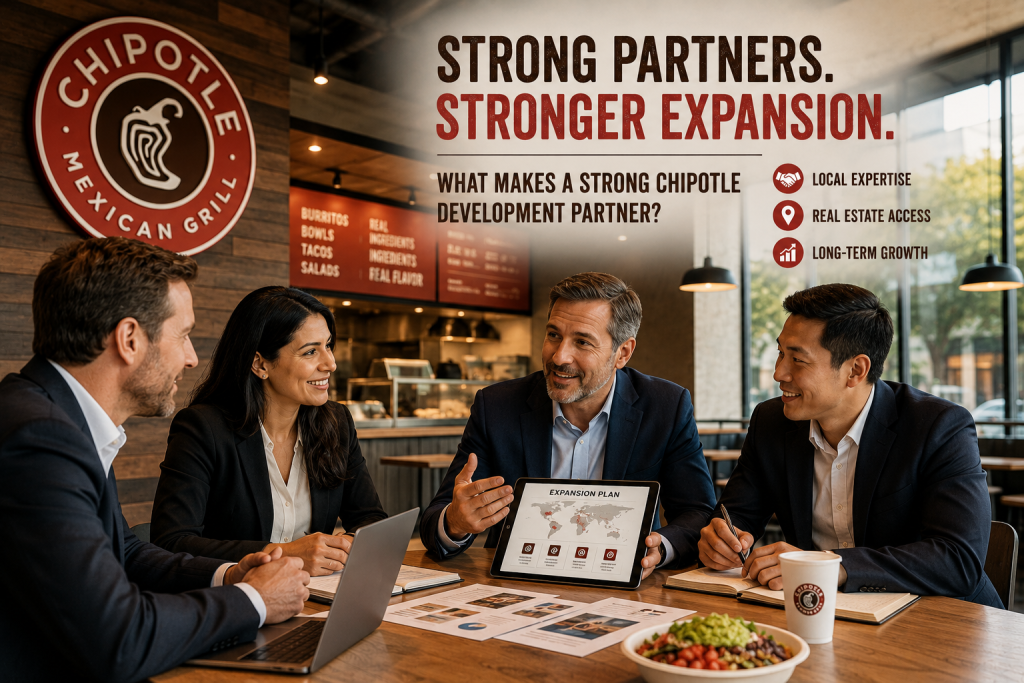
What Makes a Strong Chipotle Development Partner?
Successful restaurant expansion depends heavily on the quality of the operating partners involved. As Chipotle continues pursuing international growth, development partners play a critical role in market entry, operational execution, and long-term scalability.
Why development partners matter
International expansion requires far more than opening restaurants. Successful growth depends on real estate, staffing, logistics, operations, supply-chain management, regulatory compliance, and local market understanding.
Development partners help bridge these operational and commercial gaps while supporting long-term growth objectives.
Even globally recognized brands depend heavily on local operators, developers, and strategic partners to successfully enter and scale within new markets.
Operational experience
One of the most important characteristics of a strong development partner is operational capability.
Restaurant operators with experience managing hospitality businesses, retail systems, food-service operations, or multi-unit networks are often better equipped to execute at scale.
Real estate access
Premium locations remain critical to restaurant success. Strong development partners typically possess relationships with landlords, retail developers, shopping centers, mixed-use projects, and commercial property groups.
Access to premium shopping centers, high streets, transportation hubs, and urban retail environments.
Ability to manage site selection, build-outs, permitting, and operational rollout timelines.
Deep understanding of customer behavior, traffic patterns, and local dining trends.
Capital readiness
International restaurant development often requires substantial investment in construction, staffing, supply chains, logistics, technology, and marketing.
Strong development partners typically demonstrate the financial capability required to support long-term growth plans.
Local market expertise
Consumer preferences, regulations, labor structures, business practices, and competitive landscapes vary significantly between markets.
Local expertise helps restaurant brands adapt more effectively while maintaining operational consistency.
Understanding cultural expectations, dining behavior, pricing sensitivity, and operational realities can significantly improve long-term market performance.
Long-term commitment
Successful restaurant expansion rarely happens overnight. Strong partners typically focus on disciplined growth, operational consistency, and sustainable market development over many years.
What recent expansion activity reveals
Chipotle’s agreements with Alshaya Group, SPC Group, and Alsea all demonstrate a preference for experienced regional operators with established infrastructure and proven operating capability.
These partnerships reinforce the importance of selecting partners that combine local market strength with long-term development capacity.
Conclusion
As Chipotle continues expanding internationally, development partners will remain central to the company’s growth strategy. Strong operators, real estate groups, and strategic development partners provide the operational foundation needed for successful market entry and long-term expansion.
Explore Development Opportunities
Review market-entry pathways, development structures, expansion case studies, and strategic growth opportunities.
Leave a Reply