Multi-Unit Restaurant Development Explained
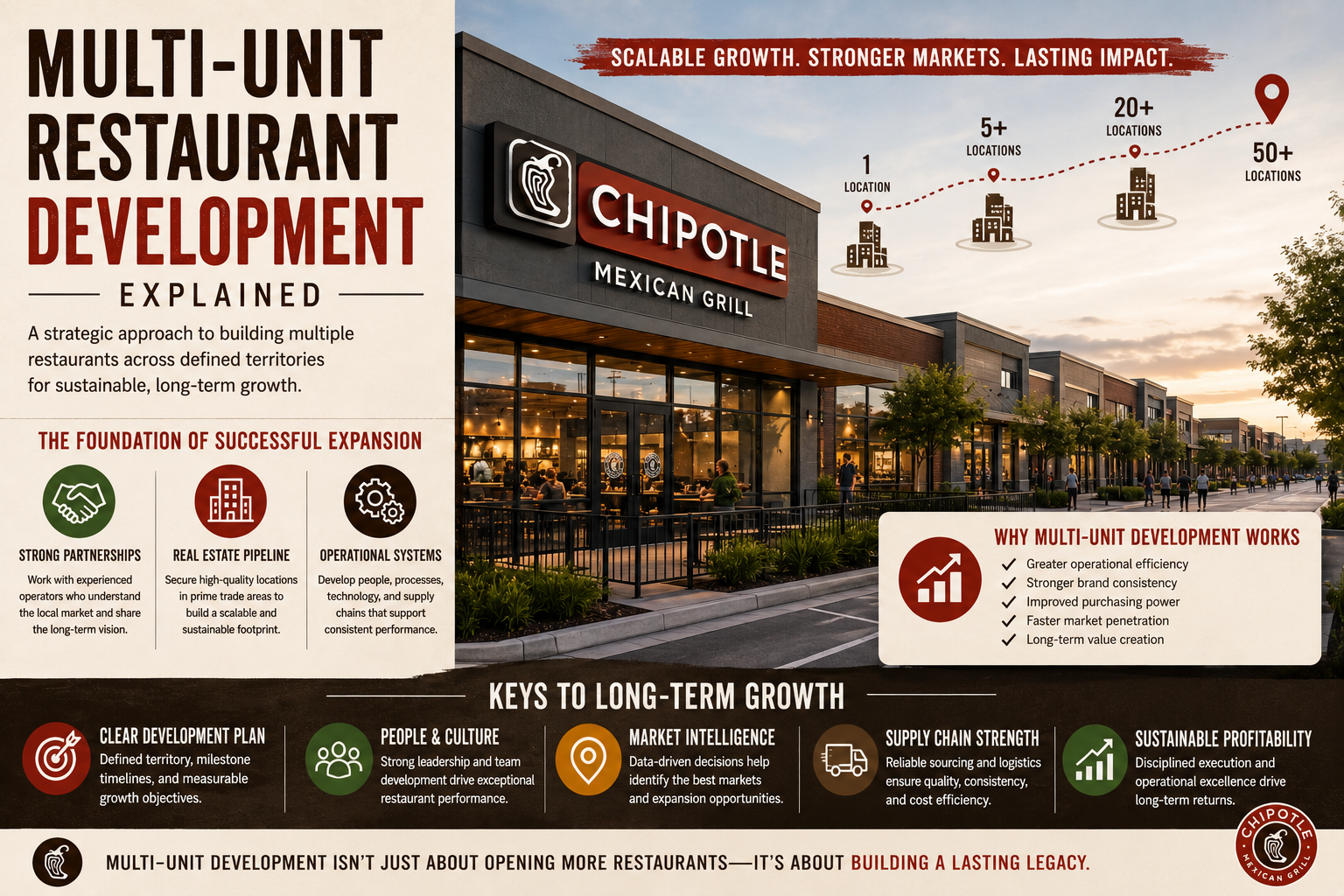
Multi-unit restaurant development has become one of the most important structures supporting global restaurant expansion. Rather than focusing on single-location operations, many growth strategies now prioritize scalable territory development and long-term operational infrastructure.
What is multi-unit restaurant development?
Multi-unit restaurant development refers to the structured expansion of multiple restaurant locations within a defined market, territory, city, or region over a planned timeline.
Instead of operating a single location independently, development groups often build systems designed for scalable long-term growth.
Large-scale restaurant growth typically requires operational infrastructure, staffing systems, real estate pipelines, supply-chain capability, and disciplined market planning.
Why major restaurant brands use multi-unit development
Global restaurant brands increasingly prioritize operators capable of supporting scalable expansion rather than isolated single-location execution.
Centralized staffing, logistics, management, and operational systems improve scalability.
Structured development timelines help accelerate long-term market penetration.
Operational systems support consistency across multiple locations and territories.
The role of real estate
Multi-unit growth depends heavily on real estate access. Strong development groups often maintain pipelines of retail opportunities, landlord relationships, mixed-use projects, and premium commercial sites.
Location quality continues influencing restaurant performance, scalability, and long-term profitability.
Groups capable of securing strong locations consistently often gain significant operational and strategic advantages during expansion.
Operational infrastructure matters
Scaling multiple restaurant locations requires far more than opening stores. Staffing systems, management structures, training programs, technology integration, and supply-chain coordination all become increasingly important as growth accelerates.
Why international expansion favors scalable operators
As restaurant brands expand internationally, many prefer development groups with proven operational experience, regional infrastructure, and the ability to support multi-location growth across several cities or territories.
This approach often reduces operational risk while supporting faster market-entry execution.
What investors and developers should understand
- Scalability matters more than isolated execution
- Operational systems drive long-term growth
- Real estate access remains critical
- Local expertise improves expansion performance
- Infrastructure often determines growth speed
- Technology integration supports operational efficiency
Recent international expansion trends
Recent restaurant expansion activity across the Middle East, Asia, and Latin America continues demonstrating how development agreements and strategic partnerships increasingly prioritize scalable multi-unit structures.
Conclusion
Multi-unit restaurant development remains one of the most important foundations of modern restaurant expansion. As brands continue pursuing international growth, scalable operational systems, real estate infrastructure, and disciplined territory development will remain central to long-term success.
Explore Development Opportunities
Review expansion pathways, development agreements, licensing structures, and strategic market-entry opportunities.
Leave a Reply