How Chipotle Selects New International Markets
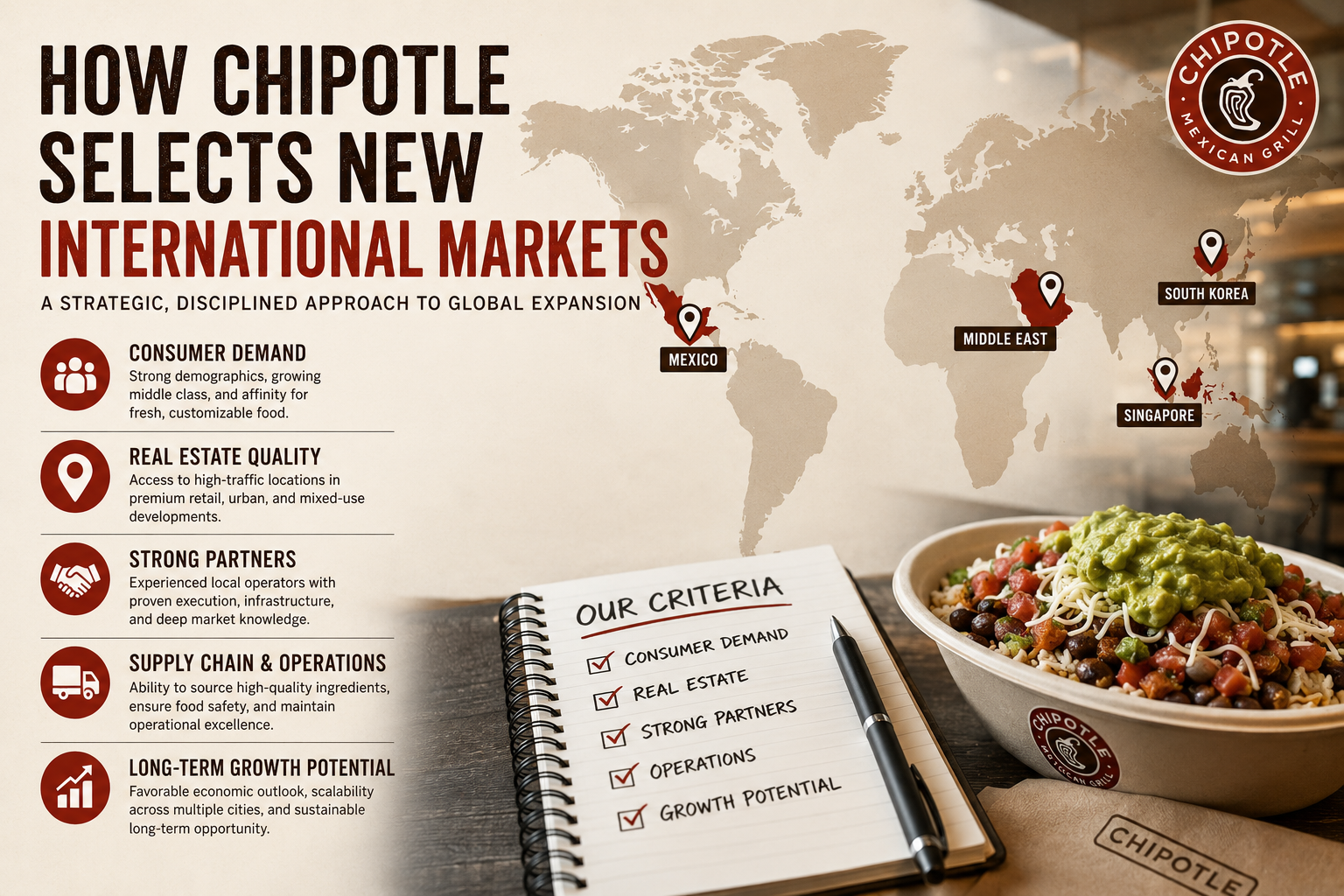
Successful international expansion requires careful market evaluation, disciplined planning, and long-term strategic thinking. As Chipotle expands beyond North America, several factors continue shaping how new markets are selected and developed.
International expansion requires discipline
Expanding into a new country involves significantly more complexity than opening additional restaurants within an existing market.
Restaurant brands must evaluate demographics, consumer behavior, supply chains, logistics, regulations, staffing, real estate quality, and long-term scalability before entering a new region.
Successful international expansion often depends on selecting markets where operational capability, consumer demand, and long-term growth potential align.
Consumer demand and dining culture
One of the most important factors in market selection is whether local consumers are likely to embrace the restaurant concept.
Markets with strong urban populations, international dining exposure, premium retail activity, and growing fast-casual demand often attract greater attention from global restaurant brands.
Real estate quality
Premium locations remain central to successful restaurant expansion. International brands frequently prioritize high-traffic retail environments, mixed-use developments, business districts, transportation hubs, and destination shopping centers.
Dense commercial districts often provide stronger customer traffic and long-term scalability.
Premium malls, lifestyle centers, and mixed-use projects can support stronger brand positioning.
Transportation access, visibility, parking, and convenience remain critical operational factors.
The importance of local operating partners
Chipotle’s recent agreements with Alshaya Group, SPC Group, and Alsea demonstrate the importance of experienced regional partners in international expansion.
Strong operators provide local expertise, infrastructure, operational capability, staffing support, supply-chain access, and real estate relationships.
Experienced local partners can significantly improve market-entry execution while helping maintain operational consistency and scalability.
Supply-chain readiness
Restaurant brands must ensure that ingredient sourcing, food safety, logistics, and operational standards can be maintained consistently across new markets.
Supply-chain feasibility often becomes one of the most important factors influencing international growth decisions.
Economic and demographic trends
Population growth, tourism activity, consumer spending power, business activity, and middle-class expansion can all influence whether a market becomes attractive for restaurant development.
Long-term scalability
Many international expansion strategies focus not only on opening initial locations, but also on whether a market can support sustainable long-term growth.
Brands often evaluate whether multiple cities, territories, or commercial districts can support future expansion over time.
What recent expansion activity reveals
Recent expansion announcements suggest that Chipotle favors disciplined market selection rather than rapid global expansion.
The company’s focus on the Middle East, Mexico, South Korea, and Singapore reflects a strategy centered around premium markets, strong operators, and scalable long-term opportunities.
Conclusion
Selecting new international markets requires balancing opportunity with operational feasibility. Consumer demand, premium real estate, supply chains, local partnerships, and scalability all play critical roles in successful expansion.
As Chipotle continues pursuing international growth, disciplined market selection will likely remain one of the most important foundations of its long-term strategy.
Explore International Expansion Pathways
Review market-entry strategies, development opportunities, licensing structures, and expansion case studies.
Leave a Reply